


Birdwatching in the Sundarbans: A Season-by-Season Guide
Most visitors come to the Sundarbans hoping for a tiger and leave having seen almost nothing. Birders come with binoculars and leave with thirty or forty species.
That is not a coincidence. The Sundarbans does not reward hoping. It rewards knowing what to look at, where, and at what state of the tide. Depending on which checklist you use, somewhere between 250 and 300 bird species have been recorded across the delta, and a patient winter morning on the right creek will give you more in three hours than a week of general sightseeing.
This is the guide we wish more of our guests arrived with.
Why The Delta Works so Well For Birds
It is the mix. Saline tidal channels meet fresher inland water, mudflats are exposed and submerged twice a day, and the mangrove canopy sits directly above both. That gives you waders on the flats, fish-eaters along the channels, raptors overhead and skulking forest species inside the canopy — four quite different bird communities within sight of one boat.
It also explains why a boat beats a watchtower for birding. The towers are fixed points with crowds on them. The creeks move you quietly through the edge habitat where the birds actually are.
What to Look For
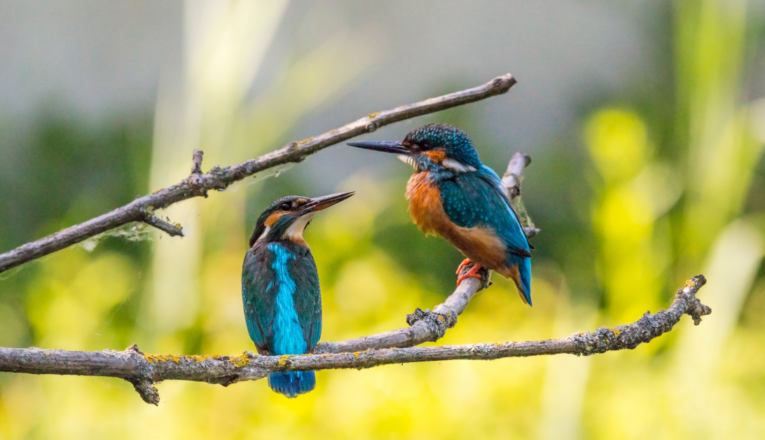
Kingfishers — The Delta’s Signature
This is the best place in India to see kingfishers in numbers and variety. Eight or more species occur here, and on a good winter day a birder can realistically log five or six of them.
- Brown-Winged Kingfisher — one of the largest kingfishers in the world and genuinely common here, which is remarkable given how restricted its range is elsewhere. Rust-orange and blue, usually perched low over the water on a mangrove root.
- Collared Kingfisher — white and turquoise, noisy, often the first one you hear.
- Black-Capped Kingfisher — striking and reasonably reliable along the narrower channels.
- Stork-Billed, Pied, Common and White-Throated Kingfishers — all regular, the pied often hovering over open water.
- Ruddy Kingfisher — shy, stays inside shaded forest, and finding one is a genuine achievement.
Raptors and Large Waterbirds
White-bellied sea eagles are the signature raptor here, often perched high on a dead mangrove limb or quartering the channel. Pallas’s fish eagle is the prize — a globally threatened species that birders travel specifically to see. Ospreys arrive in winter and hunt the open water. Brahminy kites are everywhere once you start looking.
Among the large waders, the lesser adjutant is the one worth hoping for — an ungainly, threatened stork that works the mudflats at low tide. Herons, egrets and open-billed storks are constant background, and the oriental pied hornbill turns up around Sajnekhali.
The Mangrove Specialists
These are the species that justify the trip for a serious birder, because they are difficult or impossible elsewhere.
- Mangrove Pitta — brilliantly coloured, maddeningly hard to see, and far more often heard than seen. Timing matters enormously here (see the season section below).
- Mangrove Whistler — drab and easy to overlook, but a true mangrove specialist.
- Buffy Fish Owl — occasionally roosting in dense cover along the creeks.
- Masked Finfoot — critically endangered, extremely rare, and the species every visiting birder quietly hopes for. Do not plan around it. Do scan every quiet creek edge.
Winter Migrants
From November the resident list is joined by birds arriving from Central Asia and further north: sandpipers, plovers, whimbrel and curlew on the mudflats, grey-headed lapwing, taiga flycatcher and dusky warbler in the scrub, and raptors including peregrine falcon passing through.
Season by Season
| Season | Months | What it gives you |
| Winter | November–February | The main birding season. Migrants present, clear light, calm water, comfortable full days on the boat. Best overall species count. |
| Late winter | March | Migrants still around, crowds thinning, and mangrove pitta begins calling. Arguably the sweet spot. |
| Spring | March–May | Mangrove pitta is at its most vocal and most findable. Hot and uncomfortable, but this is the window for that one species. |
| Monsoon | July–September | Poor general birding. Rain, flat light, birds less active. Go for the hilsa, not the list. |
| Early autumn | October | Shoulder month. Residents active, first migrants arriving, far fewer boats than December. |
The short version: come in winter for the broadest list, come in March if the mangrove pitta is what you want, and avoid monsoon entirely if birds are the point of the trip.
Where To Go
Dobanki
The best kingfisher location in the reserve, and the canopy walk puts you at eye level with the mid-storey rather than looking up at it from a boat. Collared, black-capped and brown-winged kingfishers are all regular here. The pitta and, very occasionally, the finfoot have been recorded in this area.
Sajnekhali
The established bird sanctuary, with a well-built tower overlooking the water channels. Fishing eagles, ibises, egrets, herons and the oriental pied hornbill are the staples. Busy in peak season — go early.
Sudhanyakhali
Better known for mammals at the sweet-water pond, but the approach creeks are productive for stork-billed and pied kingfishers, and the open view suits raptor-watching.
The Narrow Creeks
The best birding is not at any tower. It is in the small channels between them, with the engine cut and the boat drifting. This is why cruise time matters more than tower count, and why a three-night trip outperforms a two-night one for birders by a wide margin.
Pakhiralaya Itself
The village means “abode of birds” and earns it. Walk the embankment at first light before the boat leaves. Kingfishers, bee-eaters, drongos, egrets in the paddy and raptors overhead, without a permit or a boat.
Read More:
First-Time Sundarbans Trip: Which Package Should You Choose?
Practical Advice for Birders
- Binoculars Are Not Optional: 8×42 is the right compromise for a moving boat — 10x is hard to hold steady on water.
- Tell Your Guide You are Birding: Say it when you book, not on the boat. The route, the pace and which creeks you enter all change. A guide who knows calls is worth more than any other single factor.
- Ask For The Engine Off: Drifting into a creek silently is the difference between a glimpse and a view.
- Learn The Tide: Low tide exposes mudflats and brings out waders and kingfishers hunting the margins. High tide pushes birds into the canopy. Your guide can plan around it if you ask.
- Dull Clothing: Olive, grey or brown. Bright colours on an open deck are visible a long way off.
- Keep Your Voice Down: Sound carries hundreds of metres across water. A loud boat sees nothing, and this is the single most common reason people come back with a short list.
- Morning Beats Afternoon Decisively: Be on the water by first light; winter fog lifts around nine and the hour after that is the best light of the day.
- Book The Longer Package: Two cruise days instead of one roughly doubles your creek time, and creek time is what produces species.
Solitary Nook sits at Pakhiralaya, on the embankment where the birding starts before the boat does. Tell us you are coming for the birds and we will plan the route around tides and creeks rather than the standard tower circuit. Send an enquiry.