


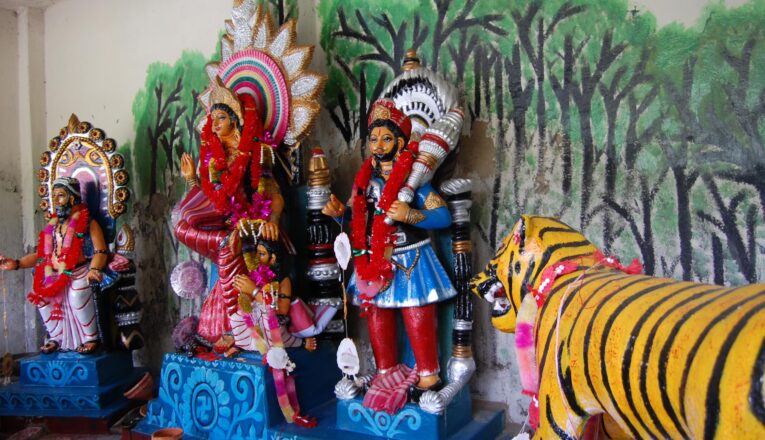
The Story of Bonbibi and Her Importance in Sundarban
Who Bonbibi is
Bonbibi is the guardian of the forest. The name means, roughly, lady of the forest, and she is worshipped across the delta by people who have to go into it to make a living.
Her story, as told in the local tradition, begins in Mecca. A fakir named Berahim — Ibrahim — had a first wife who could not bear children, and on her condition he took a second, Golalbibi. When Golalbibi became pregnant he kept his promise to the first wife and left her in the forest. Twins were born there: a daughter, Bonbibi, and a son, Shah Jangali. Bonbibi was raised in part by a deer. After seven years the family was reunited, and later the two children were sent to the mangrove country to look after the people living at the edge of it.
When they arrived, Shah Jangali gave the call to prayer over the forest. That detail tells you something about what kind of story this is.
Dakkhin Rai, and The Division of The Forest
The Forest Already Had a Ruler: Dakkhin Rai, a powerful figure who takes the form of a tiger and demands tribute from anyone entering his territory.
Bonbibi defeated his mother, Narayani, in battle — and then, instead of taking everything, gave half the kingdom back. The two became friends. That settlement is the heart of the whole tradition. The forest is divided. Bonbibi protects the inhabited edge and the people who enter it with need and humility; Dakkhin Rai holds the deep forest, and what happens there is his.
The understanding that follows is simple and strict: take only what you need, and ask first. A person who enters the forest greedily has broken the terms and is no longer under protection.
The Story of Dukhe
The story most often recited is about a poor boy named Dukhe, whose name means sorrow.
Dukhe joins a honey-collecting expedition led by a wealthy trader, Dhona. Dhona fails to make the proper offering to Dakkhin Rai, who then demands a human life in exchange for the honey. Dhona, wanting the cargo, agrees — and leaves the boy behind on the bank.
When the tiger comes, Dukhe calls on Bonbibi. She arrives with her brother, Shah Jangali drives off Dakkhin Rai, and a peace is brokered. Dukhe goes home with the wealth that was meant to be bought with his life.
It is a story about labour and class as much as about tigers. The man who breaks the compact is not the boy who goes into the forest — he is the one who sends someone else in and stays on the boat. That is not an accident, and the people who recite it know exactly what it means.
Why Hindus and Muslims Worship Her Together
This is the part visitors find most surprising, and it is entirely ordinary here.
Bonbibi is a Muslim figure by origin — the daughter of a fakir, sent from Mecca, announced by the call to prayer. She is also worshipped by Hindu families who make clay images of her and perform puja. Muslim households more often mark her place with an earthen mound, a red flag and a garland rather than an image. The principal text, the Bonbibir Johuranama, carries clear Persian and Arabic influence and was composed by Muslim poets. It is read aloud and performed as a folk drama.
There is no priestly caste attached to her. A gunin or fakir may be called to recite the protective verses before an expedition, but the worship itself does not require anyone’s permission. Fishermen, woodcutters and honey collectors of both communities often make the offering side by side at the same shrine before the same journey, because they are about to face the same risk.
One field study in Namkhana found the overwhelming majority of residents described her as their protector in a crisis. That is not folklore in the sense of something remembered. It is current.
The Honey Collectors
If you want to understand why any of this persists, look at how honey is actually gathered here.
The collectors are called Moulis. They go in during a short season in the hot months — broadly late March into early June, when the mangrove flowers are in nectar and the rock bees, Apis dorsata, have built their combs. The bees arrive around Magh and are gone by the rains.
The work is done on foot. Small groups go into the forest with smoke and a knife, locate a comb, cut it, and carry it out. There is no road, no vehicle and no fence. They are walking through tiger habitat, in the one part of the year the tigers are also most active in those areas, carrying something that smells strongly.
Before they go, there is a ritual. It is not decorative. It is what you do before walking into a forest that can kill you, and the men who perform it are not being quaint.
Sundarban honey received a Geographical Indication tag in India in 2024. If you buy a jar at Pakhiralaya, that is what you are buying — wild comb honey from a seasonal, permitted, genuinely dangerous harvest, not apiary honey. The quantities are small; Indian production runs to a few hundred tonnes across many years.
The Cost, Stated Plainly
People are killed by tigers in the Sundarbans every year. Almost all of them are fishermen, crab collectors and honey collectors — people working inside the forest on foot, not visitors on boats.
Villages on these islands have households headed by women whose husbands did not come back. They are referred to locally in a way that marks them out, and they often carry stigma on top of grief. This is not a detail to collect on a holiday. It is mentioned here only because the shrine on the riverbank makes no sense without it — Bonbibi is not a charming local custom, she is what people hold on to in the face of a real and recurring danger.
If your guide is from one of these villages, he may well have lost someone. Let him raise it if he wants to.
Read More:
Best Resorts in Sundarbans: Luxury vs Budget friendly-Which One To Choose?
What This Has To Do With Conservation
More than you would expect.
The compact at the centre of the Bonbibi tradition is a restraint on extraction: enter with need, take what you need, leave the rest, and do not cross into the deep forest where you have no business. Researchers working in the delta have repeatedly noted that this belief does work that formal regulation struggles to do — it is internalised rather than enforced, and it asks for moderation from people who could otherwise take more.
It also frames the tiger as a sovereign rather than a pest. In a landscape where people and tigers genuinely compete, a belief system that casts the tiger as a king owed respect rather than an enemy to be destroyed is worth something.
What a Visitor Can Actually See
- Shrines Along The Banks and in The Villages: Pakhiralaya and Gosaba both have them, and you will pass several from the boat. Many boats carry a small shrine on board.
- Bonbibi Mela, in Magh: The main communal observance falls in the Bengali month of Magh, roughly mid-January to mid-February, with the largest gatherings around the first days of the month. Some village fairs have run for generations. This falls squarely inside the winter tourist season, which most visitors do not realise when they book.
- Bonbibi Pala: The Johuranama performed as folk theatre — sung and acted through the night in village courtyards during the festival period. If you can see one, see it.
- The boats Themselves: Watch what the crew does before entering the forest. It is quick and easy to miss.
How to be a Decent Visitor to a Living Shrine
- Ask before photographing a shrine or anyone at it. Most people will say yes. The asking is the point.
- Do not move, rearrange or pose with the offerings or the image.
- Take your shoes off if others have.
- This is active worship, not a heritage site. Treat it the way you would a working temple or mosque at home.
- If you want to leave something, ask your guide what is appropriate rather than guessing.
- Buy honey from the village or a cooperative rather than haggling it down. The margin matters more to the seller than to you.
Solitary Nook has been at Pakhiralaya since 1995, and our crew and guides are from these villages. If you are travelling in Magh and want to see the Bonbibi observances rather than only the watchtowers, tell us when you book and we will plan the days around it. Send an enquiry.