


Which Sundarban Package Should You Book? A Straight Comparison
Most people booking a Sundarban trip pick a package by price, discover it was the wrong length once they are on the boat, and never quite say so in the review.
The awkward part is that price will not help you here. Three of our four itineraries cost the same — ₹6,700 per person. Same boat, same cottages, same crew, same watchtowers. What separates them is time on the water and the season you come in, and those are the two things that decide whether the trip works.
Here is the honest version of each.
The short version
| 1N / 2D | 2N / 3D | 3N / 4D | Ilish Utsav | |
| Price per pax | ₹6,700 | ₹6,700 | ₹8,500 | ₹6,700 |
| Cruise days | One | One full day | Two full days | One full day |
| Village walk | No | Yes | Yes, unhurried | Yes |
| Best season | Winter only | Winter | Winter | Monsoon |
| Suits | Fixed short dates | Most first-timers | Birders, photographers | Food and quiet |
| Book ahead | 3–4 weeks | 4–6 weeks | 6 weeks | 2–3 weeks |
2 Nights / 3 Days — The One Most People Should Book
This is the itinerary we recommend to most first-time visitors, and the one our returning guests book again.
Two nights is the point where a Sundarban trip stops feeling rushed. You get a complete day on the water rather than a compressed morning, which matters more than it sounds: the deeper creeks are only reachable when the tide cooperates, and a full day gives the boat the flexibility to wait for it.
You are picked up at Godkhali and brought across by boat to Gosaba, then on to the resort at Pakhiralaya. Lunch is at the resort, followed by the Rabindranath Tagore Bungalow, the Hamilton Bungalow and the surrounding village. Evening snacks at the resort; a cultural programme can be arranged on prior request, at additional cost.
Day two is the full cruise — Sajnekhali, Sudhanyakhali and Dobanki with its canopy walk, with lunch cooked and served on the boat, returning along the river bank to Pakhiralaya in the evening. Day three is a village walk and the mangrove plantation before lunch and departure.
All meals are included from arrival to departure: breakfast, lunch, evening snacks and dinner. Forest permits and the licensed guide are arranged for you; carry original photo ID for every guest.
Best months are November to February: when the light is clear, crocodiles come out onto the mudbanks and the migratory birds arrive. December and January weekends book out four to six weeks ahead.
₹6,700 per person. Children under five stay free where no extra bed is needed.
Read More:
Godkhali to Godkhali Itineray 2 N 3 D
1 Night / 2 Days — Only If Your Dates are Fixed
The shortest trip we run, and the honest brief on it is this: take it if your dates are fixed, not because it is the better package.
One night gives you the essentials. You are picked up at Godkhali and crossed by boat, stopping at the Hamilton and Beacon Bungalows at Gosaba, then straight into the forest cruise — Sajnekhali, Sudhanyakhali and Dobanki — with lunch served on the boat. You reach the resort in the late afternoon for snacks and dinner. The following morning, after breakfast, the boat takes you back to Godkhali.
What you gain is a real Sundarban day without needing three days off. What you give up is time. There is no second cruise, no village walk, and less flexibility if the tide or weather shifts the schedule. If you have any room in your calendar, the two-night itinerary is worth the extra day — and since both cost the same, the only thing it costs you is the day itself.
This package suits weekend travellers from Kolkata, guests fitting the delta into a longer Bengal trip, and anyone testing whether the Sundarbans is for them before committing to a longer stay.
All meals from arrival to departure are included, along with forest permits and a licensed guide. Bring original photo ID for each guest and cash — there are no ATMs at Pakhiralaya.
Winter is strongly preferred for a short trip: With only one cruise, you want the season where sightings are most likely, and that is November to February.
₹6,700 per person.
Read More:
3 Nights / 4 Days — For Birders and Photographers
Three nights is for people who want the delta rather than a checklist of watchtowers.
The difference is a second full day on the water. On a two-night trip, one cruise has to cover Sajnekhali, Sudhanyakhali and Dobanki, which means moving on schedule. With two cruise days, the boat can sit still. You can wait out a tide, spend an hour on one creek instead of ten minutes, take a slower route back through the narrow channels, and reach Panchamukhani where five rivers meet.
This matters most to two kinds of guest. Birders, because the Sundarbans holds several hundred species and the good sightings come from patience rather than distance — kingfishers, lesser adjutants, ospreys, Brahminy kites, and in winter the migrants on top. And photographers, who need to be in the right creek at the right hour rather than wherever the schedule puts them.
The extra day also leaves room for the parts of the delta that are not forest: a longer village morning at Pakhiralaya or Gosaba, the mangrove plantation, and the Tagore Bungalow without checking the clock.
All meals are included throughout, along with forest permits and a licensed guide. Cottage accommodation, river-facing, with all modern facilities.
Book this one for winter: November to February gives you the clear light, the migratory birds and calm water that make two cruise days worth paying for.
₹8,500 per person.
Read More:
Ilish Utsav — The Same Trip in a Different Season
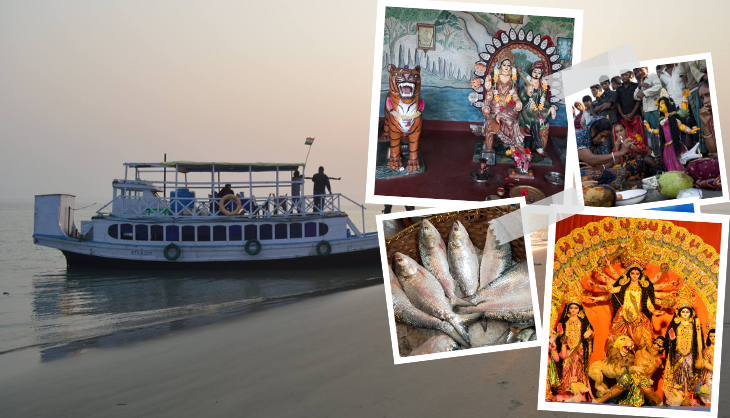
The hilsa arrives in a window, and when it does the whole delta rearranges itself around it.
Our Ilish Utsav package is the same two nights and three days as our regular itinerary, at the same price, in a completely different season. The rivers run full and fast. Everything on the banks is green in a way winter never manages. And the water is almost empty, because the tourist crowd does not return until November — which means you can cut into a creek and hear nothing but the engine and the rain.
The food is the reason most guests come. Over two nights our kitchen serves fresh river hilsa several ways — shorshe ilish, bhapa, begun diye ilish, paturi — sourced from the local catch rather than frozen stock. By the last meal you will have a favourite.
The cruise still runs the full route: Sajnekhali, Sudhanyakhali, Dobanki and the Panchamukhani confluence. Wildlife sightings are lower in monsoon, as water levels rise and animals move deeper into the forest, so treat a crocodile or a kingfisher as a bonus rather than the plan. Come for the food, the rain and the quiet, and the trip delivers everything it promises.
Evenings at the resort include a cultural programme on request. All meals, forest permits and a licensed guide are included.
Season: monsoon, with festival dates announced each year. Book two to three weeks ahead for weekend batches.
₹6,700 per person.
Still deciding? Answer These Three
How Many Days Can You Actually Give It?
Not how many you would like to — how many you have. Godkhali is three and a half to four and a half hours from Kolkata each way, so a one-night trip is mostly travel. If the answer is three days, take the 2N/3D. If it is two, take the 1N/2D and go in winter.
Do You Want to See Things, or Eat and Switch Off?
Wildlife means winter, and it means at least one full cruise day. Food and quiet means monsoon and the Ilish Utsav. These are not the same holiday and no package does both well.
Are You Carrying Binoculars or a Camera?
If yes, book three nights. The second cruise day is the whole reason the 3N/4D exists, and birders who book two nights almost always say afterwards they wish they had taken the extra day.